1. Exhibit integrity – A person is said to have integrity if what they say and what they do are rooted in the same set of core values.
2. Don’t speak badly of others – If you speak badly about others to a friend, the chances are you’ll also speak badly about them. Hence, they are likely to be hesitant in what they share with you.
3. Be an optimist – This doesn’t mean burying your head in the sand. It means choosing not to dwell on the negatives, and actively looking for the positives.
4. Make the effort to be helpful – Life is so much sweeter if you’re thoughtful and kind – and we rarely forget someone who’s caring and warm.
5. Set some goals and have some ambition – This is an extremely contagious quality. Not only will you achieve higher goals for yourself, you’ll give hope to others, and inspire them to try.
6. Seek to be compassionate and understanding – All of us face battles and experience hard times. Empathising with others when life is tough helps to ease their burden and renew their inner spark.
7. Believe in, love and respect yourself – If you don’t accept, respect and love yourself, then you’ll send out vibes that you’re inadequate. However, it you love, believe in and treat yourself well then it’s likely that others will treat you that way, too.
8. Persist until you succeed – Although ambition is important, it is not enough. You have to persevere if you’re going to succeed. So when you stumble or fall down just get up and start again. Then keep on going till you finally succeed.
9. Be open minded and willing to learn – If you’re closed in your thinking and set in your ways then you’ll never discover a different, better way .. and you’ll close yourself off to other possibilities.
10. Take responsibility for your life – Blaming others for your problems, or acting like a victim won’t help you to move forwards, and have the life you want. Take control of your destiny. Success is up to you.
Showing posts with label psychology. Show all posts
Showing posts with label psychology. Show all posts
Tuesday, August 4, 2015

Monday, April 6, 2015
— It is 2015. Stop romanticizing depression.
“Depression is not Lana Del Rey music, with smeared black eyeliner and tears running down your face. It is not a blood-stained tub, or the blade sitting across from you. It is not being rocked back and forth by a boy as he kisses your head and whispers “I love you,” repeatedly in your ear. Depression is not the dread you feel when the person you love the most doesn’t text you back. Depression is disgusting. It is low and filthy and dirty and it eats you away, bit by bit. Depression is the stale smell of your room and your clothes, because you have no energy to clean anything. It is sitting in the bathtub for hours as you feel that dirty type of clean, letting the hot water run down your body in no aims to stand up and turn it off. It is the hunch in your back and the the defeated slouch in your shoulders, the kind that your parents always try to fix, exclaiming “Sit up straight,” but what good does that ever do. Depression is the hours spent lying in your bed, trying desperately to fall asleep but never being able to. It is your eyes being so heavy-lidded and the circles under them that don’t fade, even after a good nights sleep. Depression is the sinking feeling you get when you enter school and your mind is already set - why would you care about your grades when you don’t even care about your life? It is the darkest kind of dark, the kind that intoxicates your brain and turns your best friends to enemies, your family to people you simply push away so they don’t have to hurt just because you do. It is the raw feeling of emptiness, the kind that gnaws at your very insides and leaves you nothing more than a walking skeleton, incapacitated and incapable of feeling anything but sorrow and sadness for nobody but yourself. Depression is the deepest hole you could ever think of, the only one you could ever think of because you dug it yourself. It is being not only unable, but unwilling to pull yourself up, having the darkness swallow you whole. Depression is not rain. It is being unable to see the sun, even after the rain has passed.”
Tuesday, September 2, 2014
Breaking the Habit of Comparing Yourself With Others
So how do you break this cycle of comparing yourself with others? Here are some tips I’ve found useful:
Awareness. Most often we do these social comparisons without realizing we’re doing it. It’s a natural act, I suppose, and as a result it’s something that is done without consciousness. So the solution is to become conscious — bring these thoughts to the forefront of your consciousness by being on the lookout for them. If you focus on these thoughts for a few days, it gets much easier with practice, and soon it’ll be hard not to notice.
Stop yourself. Once you realize you’re doing these comparisons, give yourself a pause. Don’t berate yourself or feel bad — just acknowledge the thought, and gently change focus.
Count your blessings. A better focus is on what you do have, on what you are already blessed with. Count what you have, not what you don’t. Think about how lucky you are to have what you have, to have the people in your life who care about you, to be alive at all.
Focus on your strengths. Instead of looking at your weaknesses, ask yourself what your strengths are. Celebrate them! Be proud of them. Don’t brag, but feel good about them and work on using them to your best advantage.
Be OK with imperfection. No one is perfect — intellectually, we all know that, but emotionally we seem to feel bad when we don’t reach perfection. You aren’t perfect and you never will be. I certainly am not, and I’ve learned to be OK with that. Sure, keep trying to improve, but don’t think you’ll ever be the “perfect person”. If you look at it in a different way, that imperfection is what makes you who you are, you already are perfect.
Don’t knock others down. Sometimes we try to criticize others just to make ourselves look or feel better. Taking someone else down for your benefit is destructive. It forms an enemy when you could be forming a friend. In the end, that hurts you as well. Instead, try to support others in their success — that will lead to more success on your part.
Focus on the journey. Don’t focus on how you rank in comparison to others — life is not a competition. It’s a journey. We are all on a journey, to find something, to become something, to learn, to create. That journey has nothing to do with how well other people are doing, or what they have. It has everything to do with what we want to do, and where we want to go. That’s all you need to worry about.
Learn to love enough. If you always want what others have, you will never have enough. You will always want more. That’s an endless cycle, and it will never lead to happiness. No matter how many clothes you buy, no matter how many houses you own (seven, in the case of one famous candidate), no matter how many fancy cars you acquire … you’ll never have enough. Instead, learn to realize that what you have is already enough. If you have shelter over your head, food on the table, clothes on your back, and people who love you, you are blessed. You have enough. Anything you have over and above that — and let’s admit that all of us reading this blog have more than that — is more than enough. Be good with that, and you’ll find contentment.
Awareness. Most often we do these social comparisons without realizing we’re doing it. It’s a natural act, I suppose, and as a result it’s something that is done without consciousness. So the solution is to become conscious — bring these thoughts to the forefront of your consciousness by being on the lookout for them. If you focus on these thoughts for a few days, it gets much easier with practice, and soon it’ll be hard not to notice.
Stop yourself. Once you realize you’re doing these comparisons, give yourself a pause. Don’t berate yourself or feel bad — just acknowledge the thought, and gently change focus.
Count your blessings. A better focus is on what you do have, on what you are already blessed with. Count what you have, not what you don’t. Think about how lucky you are to have what you have, to have the people in your life who care about you, to be alive at all.
Focus on your strengths. Instead of looking at your weaknesses, ask yourself what your strengths are. Celebrate them! Be proud of them. Don’t brag, but feel good about them and work on using them to your best advantage.
Be OK with imperfection. No one is perfect — intellectually, we all know that, but emotionally we seem to feel bad when we don’t reach perfection. You aren’t perfect and you never will be. I certainly am not, and I’ve learned to be OK with that. Sure, keep trying to improve, but don’t think you’ll ever be the “perfect person”. If you look at it in a different way, that imperfection is what makes you who you are, you already are perfect.
Don’t knock others down. Sometimes we try to criticize others just to make ourselves look or feel better. Taking someone else down for your benefit is destructive. It forms an enemy when you could be forming a friend. In the end, that hurts you as well. Instead, try to support others in their success — that will lead to more success on your part.
Focus on the journey. Don’t focus on how you rank in comparison to others — life is not a competition. It’s a journey. We are all on a journey, to find something, to become something, to learn, to create. That journey has nothing to do with how well other people are doing, or what they have. It has everything to do with what we want to do, and where we want to go. That’s all you need to worry about.
Learn to love enough. If you always want what others have, you will never have enough. You will always want more. That’s an endless cycle, and it will never lead to happiness. No matter how many clothes you buy, no matter how many houses you own (seven, in the case of one famous candidate), no matter how many fancy cars you acquire … you’ll never have enough. Instead, learn to realize that what you have is already enough. If you have shelter over your head, food on the table, clothes on your back, and people who love you, you are blessed. You have enough. Anything you have over and above that — and let’s admit that all of us reading this blog have more than that — is more than enough. Be good with that, and you’ll find contentment.
Tips for Dealing with Rejection
1. First, recognise that not everyone is like you. We have different likes and dislikes, we want different things, and we all see people and the world in different ways. Hence, it is natural that sometimes people will be upset, offended, or react differently from what we expected. It’s not necessarily personal – it’s more a reflection of the fact that we all are different.
2. Try and leave your emotions aside and objective analyse the situation. Ask yourself: “Is this person’s reaction triggering something me?” It could be that you are over-reacting to a perceived rejection because of previous hurts, put downs and rejections. Alternatively, the other person’s reaction could be more related to what is going on in their life at the time (rather than being a personal rejection of you.)
3. Be alert to over-generalising and over-personalising. For example, look out for the tendency to think things like that “That means I’m a terrible person, and no-one likes me” or “I never do anything right. I always say and do the wrong thing. I’m always going to get it wrong and be rejected by everyone.”
4. Look for friendships and affirmation in other places. It’s wise to have a wide range of friends and acquaintances so that our self-image and self-esteem aren’t tied into how a few key people treat us, or react towards us.
5. Accept that snubs and rejections are part of life. We can’t please all of the people all of the time – we can only please some of the people some of the time. And while it’s wise to check to see if we display certain habits, traits or behaviors that often annoy others (and it is wise to work on changing those), at the end of the day we just have to be ourselves. We can’t spend our lives walking on egg shells, or trying to be someone we were never meant to be.
2. Try and leave your emotions aside and objective analyse the situation. Ask yourself: “Is this person’s reaction triggering something me?” It could be that you are over-reacting to a perceived rejection because of previous hurts, put downs and rejections. Alternatively, the other person’s reaction could be more related to what is going on in their life at the time (rather than being a personal rejection of you.)
3. Be alert to over-generalising and over-personalising. For example, look out for the tendency to think things like that “That means I’m a terrible person, and no-one likes me” or “I never do anything right. I always say and do the wrong thing. I’m always going to get it wrong and be rejected by everyone.”
4. Look for friendships and affirmation in other places. It’s wise to have a wide range of friends and acquaintances so that our self-image and self-esteem aren’t tied into how a few key people treat us, or react towards us.
5. Accept that snubs and rejections are part of life. We can’t please all of the people all of the time – we can only please some of the people some of the time. And while it’s wise to check to see if we display certain habits, traits or behaviors that often annoy others (and it is wise to work on changing those), at the end of the day we just have to be ourselves. We can’t spend our lives walking on egg shells, or trying to be someone we were never meant to be.
Friday, March 7, 2014
Monday, February 10, 2014
How To Know When To Say “I Love You”
Saying “I Love You” for the first time is scary. Who says it first? What’s the right way to say it? Here are 10 ways to know that you’re ready to say those three little words:
Thursday, January 30, 2014
maybe this is what is happening ---
"And once you lose yourself you have to find the person you used to be or lose that person completely"
How to Connect Through Open Body Language
1. Be sensitive to body space. Don’t stand too far away from the person, or fold your arms across your chest. That sends the message “I don’t want to get close”. At the same time, don’t invade the person’s space – as standing too close is highly threatening.
2. Maintain steady but soft eye contact. If you avert your gaze that says you’re insecure; but staring for too long is intimidating. Eye contact should be confident and comfortable.
3. Invite the other person into your thought processes. Share your ideas, and think aloud. Also, welcome their comments – and don’t just brush them off.
Wednesday, January 29, 2014

Tuesday, January 28, 2014
— I can think of things that hurt me
“Etch his name into your bedroom floor so you have to get over him every morning.”
Saturday, January 25, 2014
Why Rejection Is Good
There’s no doubt that rejection is painful. Whether it’s from someone you like and are asking out, or a job you really wanted, rejection is a tough pill to swallow. Unfortunately it’s a necessary part of life, but the good news is that rejection can actually be a good thing. Even though it won’t feel like it at the time, there is lots of good that can come from rejection. Here are just some of the ways that rejection can be a good thing:
It builds character. Someone who’s had everything handed to them on a silver platter just isn’t as interesting as someone who’s had to work hard for where they are in life. The most inspirational stories are those of people who have been down and out and rejected time and time again before finally finding success. So while rejection stings at first, try to think of it as one more interesting thing about you, or one more way that you’re growing as a person.
Friday, January 24, 2014
Psychology and Friendships
The following psychological terms can be used to describe what happens in friendships.
1. Triangles – This is where 2 people strengthen the bond between them, or lessen insecurity and anxiety, by sharing complaints about a friend.
2. Emotional contagion - This is where we pick up the mood of those we are hanging out with. Thus, if they are feeling angry and negative, then we start to feel the same way, too.
3. The exposure effect - This is where people who spend time together find they start to like the same sorts of things (music, food, movies, clothes etc). They also rate each other more highly in terms of how nice or attractive the other person is.
4. The fundamental attribution error - This is where we overestimate the role of character traits and personality factors when someone we know does something wrong or stupid … But we overestimate the role of circumstances when it is us who has done something wrong or stupid!
5. Situation evocation - This refers to the fact that if we act is certain ways, people will respond or react in the same way, which then sets a cycle of “more of the same” in motion. For example, if I joke around, others will start being funny too, and then I’ll reply with something else light hearted and fun … and so on.
1. Triangles – This is where 2 people strengthen the bond between them, or lessen insecurity and anxiety, by sharing complaints about a friend.
2. Emotional contagion - This is where we pick up the mood of those we are hanging out with. Thus, if they are feeling angry and negative, then we start to feel the same way, too.
3. The exposure effect - This is where people who spend time together find they start to like the same sorts of things (music, food, movies, clothes etc). They also rate each other more highly in terms of how nice or attractive the other person is.
4. The fundamental attribution error - This is where we overestimate the role of character traits and personality factors when someone we know does something wrong or stupid … But we overestimate the role of circumstances when it is us who has done something wrong or stupid!
5. Situation evocation - This refers to the fact that if we act is certain ways, people will respond or react in the same way, which then sets a cycle of “more of the same” in motion. For example, if I joke around, others will start being funny too, and then I’ll reply with something else light hearted and fun … and so on.
Monday, January 13, 2014
— Helen Mirren
“It seems to me that the years between eighteen and twenty-eight are the hardest, psychologically. It’s then you realize this is make or break, you no longer have the excuse of youth, and it is time to become an adult – but you are not ready.”
Thursday, January 9, 2014

Thursday, December 26, 2013
— C.G. Jung
“Sensation tell us a thing is.
Thinking tell us what it is this thing is.
Feeling tells us what this thing is to us”
Wednesday, December 25, 2013
it took me a rewatch to notice this, but the progression of elsa’s facial expressions in this sequence is frightening.

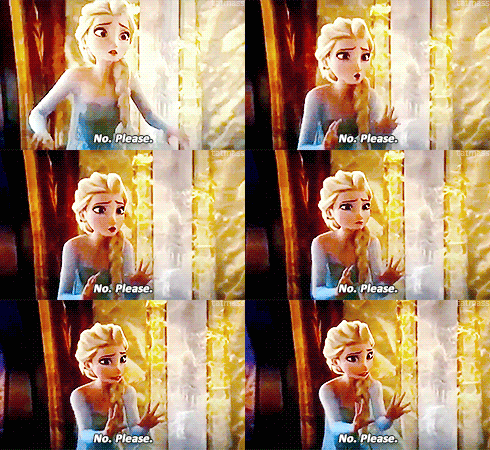







she starts off using her magic purely for self defense. every blast of it she throws, there’s a look of pure fear of her face. she doesn’t want to be doing this, she doesn’t want to hurt anyone, she just wants them to stop attacking her, please, please stop.
but the longer the fight goes on, the more they keep up their attacks, that fear slips away and makes room for something much darker. anger. hate. suddenly she’s not just acting in self-defense anymore, she is actively attacking, very well near impaling one man and fully intent on sending the other to a fall to his death.
hans’ words are what snaps her out of it, and she is horrified because she realizes how right he is. how very, very close she just came to becoming a monster.
it’s horrifying because, if he hadn’t called her out then — if they had simply continued to fight against her as a threat that had to be conquered — she may well have never snapped out of it. she would’ve become consumed by her rage and hatred, and the pure heart she’s clung on to for so many years would turn to black ice.
throughout the movie, elsa was never once a villain. she was an antagonist by the demands of the story structure alone — there was never a drop of badness in her, never a real desire to bring harm to people.
until this moment. this moment, where her soul was almost completely lost.
I wasn’t kidding when I said I think Elsa is one of the most complex characters I’ve watched in a long time and the commentary above helps explain why. I love this sequence for that reason. Elsa starts off completely in flight-mode (she wants to run away from them, and pleads with them to leave her alone) but as the scene progresses she realizes they’re not going to stop until they kill her, so her flight-mode leaves and her fight-mode completely takes over. I have to say I do see her actions throughout as self-defense, but I do agree killing someone would have completely changed her and broke her. Afterwards she would have felt like the monster she always feared she was.
Monday, December 23, 2013
How to Listen to your Heart
You’ll find that life is more rewarding if you listen to your heart – as well as listening to your rational mind.
Why do we bother with relationships?
"Why do we bother with relationships? Neuropsychiatrists say that we are hardwired to crave intimate connections. We long for love. Of course the reality is it usually ends in heartache. Leaving our delicate psyches bruised if not completely shattered. Why do we even bother playing those odds? I guess because we only have to get it right once. And when it’s right, you know it. Even the memory of the fulfilling relationship can sustain us; and remind us that, although we may be down at this particular moment, we’re never truly alone."
Labels Against Women


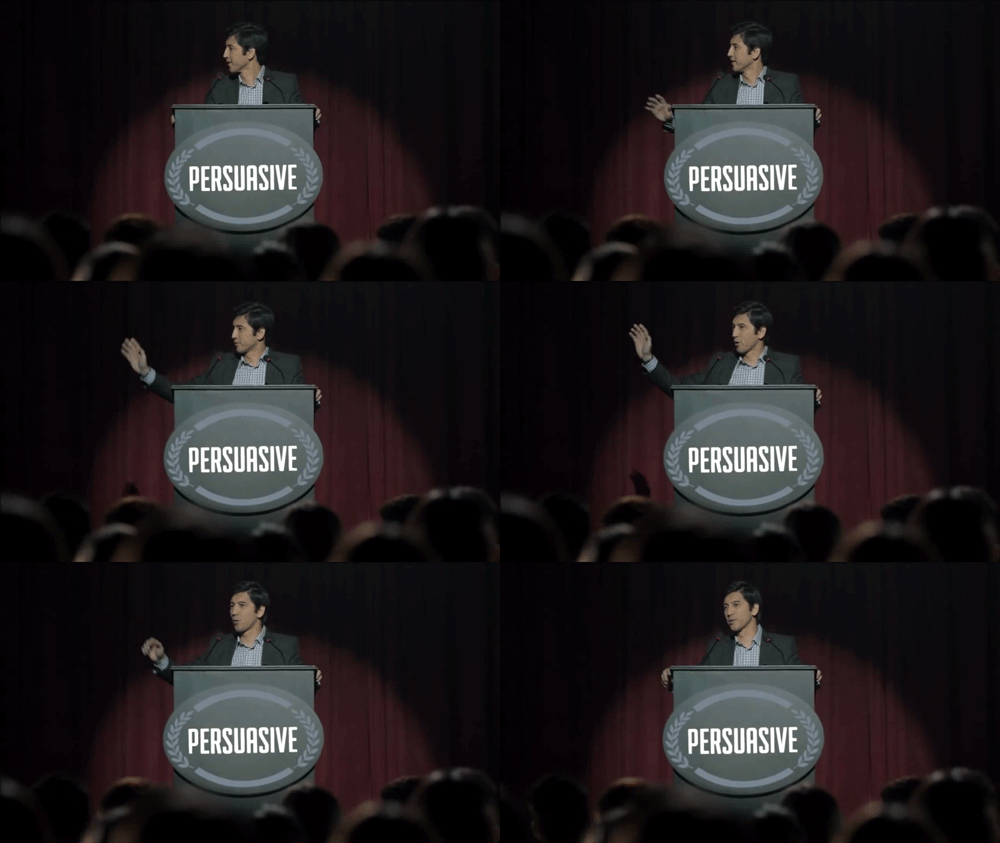
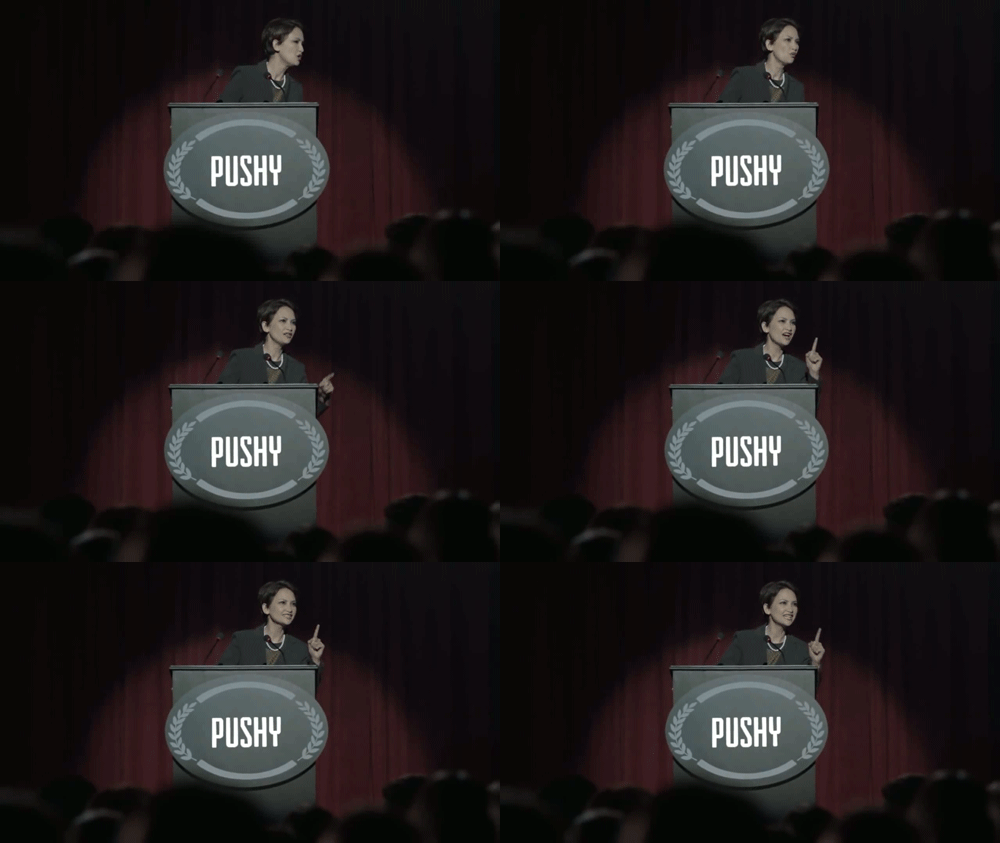
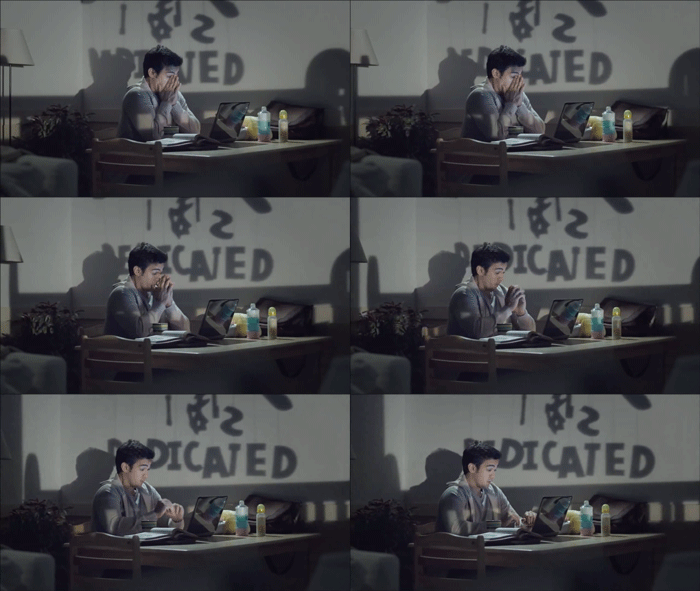



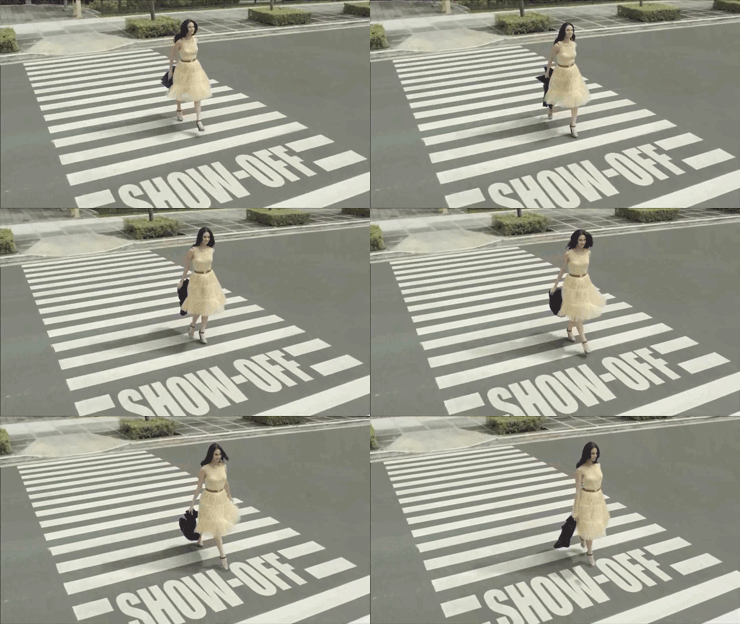
Does gender bias still exist? If the answer is no, then why is it that women who take charge tend to be called bossy, whereas men who do the same is just doing his job as a boss? Or why is it that when mothers are passionate about their career, they tend to be seen as selfish, while working dads are dedicated? It is also quite startling that a recent study said 70% of men feel that women need to downplay their personality in order to be accepted.
According to the 2013 Global Gender Gap Report, the Philippines ranks number 5 in gender equality. But a survey by the social news network, Rappler, revealed that gender bias is still very much prevalent. One thought-provoking statistic showed that 77% of males and 66% of females believe that men deserve employment more than women -- clearly reinforcing that bias exists in the workplace. Research findings show that both genders have prejudices and are prejudiced against.
Pantene, a brand that stands for empowering women to shine boldly, highlighted the issue of double standards and the culture of inequality that people have come to accept as the norm. Although initially approached from a local standpoint, the campaign resonated to the global market, recognizing an idea that was inspired by a hard-hitting reality that every woman faces.
Thus, #WhipIt was created. Urging women to leave labels behind, and be strong and shine.
Learn more about the movement and join the conversation here: http://www.rappler.com/brandrap/whipit
source: http://www.youtube.com/watch?v=kOjNcZvwjxI
According to the 2013 Global Gender Gap Report, the Philippines ranks number 5 in gender equality. But a survey by the social news network, Rappler, revealed that gender bias is still very much prevalent. One thought-provoking statistic showed that 77% of males and 66% of females believe that men deserve employment more than women -- clearly reinforcing that bias exists in the workplace. Research findings show that both genders have prejudices and are prejudiced against.
Pantene, a brand that stands for empowering women to shine boldly, highlighted the issue of double standards and the culture of inequality that people have come to accept as the norm. Although initially approached from a local standpoint, the campaign resonated to the global market, recognizing an idea that was inspired by a hard-hitting reality that every woman faces.
Thus, #WhipIt was created. Urging women to leave labels behind, and be strong and shine.
Learn more about the movement and join the conversation here: http://www.rappler.com/brandrap/whipit
source: http://www.youtube.com/watch?v=kOjNcZvwjxI
Friday, December 20, 2013
8 Important Life Lessons
- You only have this moment so live in the “now”.
- Life is over quickly so fight for what matters – your values and beliefs … hopes and dreams … and those you love.
- If you make the sacrifice, you will reap the benefits.
- Procrastination keeps you tied to yesterday. For what you do today will determine your tomorrow.
- See failure as lesson, and a bridge to success. We all fail at times – it’s the way we grow and learn.
- The most important relationship you have in this the life is the relationship that you have with yourself. So value, affirm and believe in yourself.
- What we do – not what we say – reveals our true character.
- Remember to be kind for everyone is fighting a hard battle.
Subscribe to:
Posts (Atom)